


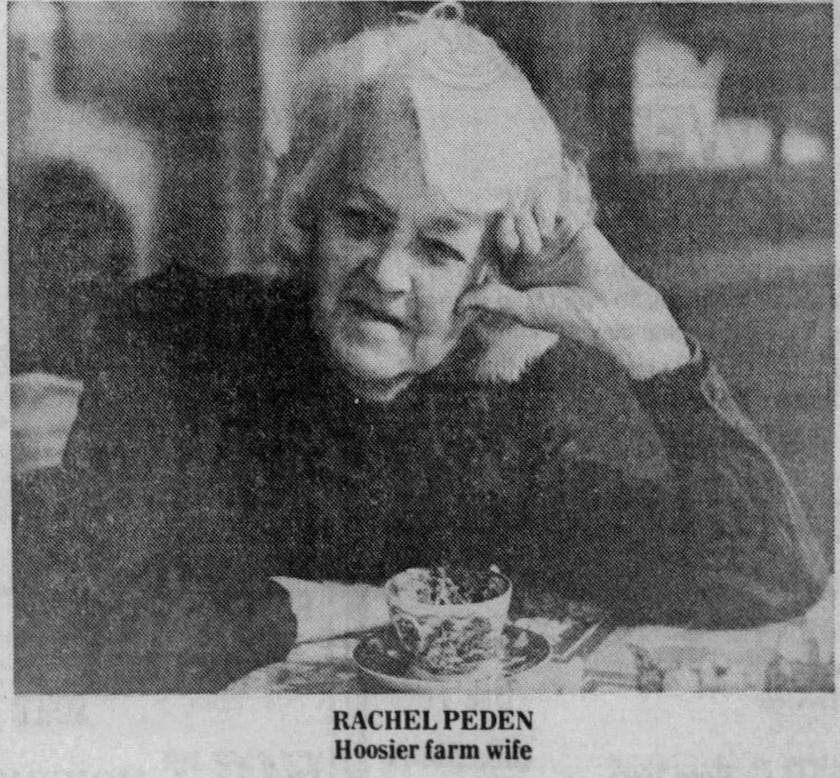
My introduction to Rachel Peden came via a comment left sometime in June of this year.
“Please check out Rachel Peden’s Rural Free: A Farmwife’s Almanac of Country Living (1967), the book that turned me onto this “genre” of writing gardening and nature books by month of the year. For starters try this link https://www.magbloom.com/wp-content/uploads/2012/02/Peden.pdf " - Rachel M.
(I recommend reading that article linked to as a PDF to learn more about Rachel Peden, after you finish reading this brief Substack article about her.)
I found the audiobook for Rural Free on Audible, bought it, downloaded it, listened to it, and loved it. I will listen to it again and again.
I was also quite surprised that I had never heard of Rachel Peden, who wrote a column that appeared four times a week in The Indianapolis Star from the 1940s until her death in 1975. Surely, during those later years when I was growing up and we got that paper every day, I would have read one or more of her columns? Regardless, I did not know about her but now I do, and my reading life is better for it.
Would you also like to improve your life by reading books by Rachel Peden? Let’s meet her.
Her Biography
I picked up a bit of Rachel’s biography from her third book, published in 1974.
“Rachel Peden was born in Redkey, Indiana, and was graduated from Indiana University with a degree in sociology. Since 1946 she has been writing a farm column for The Indianapolis Star and the Muncie Evening Press. Mrs. Peden and her farmer husband have two grown children and make their home near Bloomington, Indiana.”
To this I can add that she was born Rachel Mason on December 17, 1901 and passed away on August 16, 1975 at the age of 73.
I picked up some other tidbits from her obituary in The Indianapolis Star. She started her education in a one-room school house before attending Martinsville (Indiana) High School. After high school, she earned her degree from Indiana University in three and a half years and was elected to Phi Beta Kappa, a scholastic honorary society. After college, she worked as reporter for The Martinsville Reporter before becoming the women’s editor of Farm Life magazine, a job she held until that magazine went out of business in 1929.
She married her husband, Richard, in 1929, and they had two children, a son and a daughter. They purchased their farm, located near Bloomington, Indiana, in 1941.
Her Newspaper Columns
Rachel often wrote letters to her sister, Nina, who was married to Eugene C. Pulliam, publisher of The Indianapolis Star, and several other newspapers. Nina shared Rachel’s letters with her husband, who was impressed by her writing and offered her a column on the editorial page of The Indianapolis Star and The Muncie Evening News. She wrote two columns. “The Hoosier Farmwife Says” was signed “Mrs. R. F. D.” and appeared on the editorial page. Her other column, “The Almanac of Poor Richard’s Wife” had no by-line and was usually in the Saturday edition of the newspaper.
She generally wrote about life and people on and around the farm, and sometimes yes, about gardening.
I spent quite a bit of time browsing her columns on newspapers.com archives. Here’s one nugget I found, which though not about gardening, is a lovely lesson on living:
“The reason I took up painting,” said an amateur artist who really isn’t bad with water colors, “was, I was cleaning out the family desk and found a box of water color paints left over from when one of the children was in school. When I was in grade school we didn’t use paints, just crayons. I didn’t know what to do with the paints. I always like to use up stuff and throw away the containers. So I just started painting any old thing, smearing the paint around. By the time my painting began to look like something, the paint was gone, and I was enjoying it so much I bought a new box and began in earnest.” “Well then,” said her skeptical listener, “actually you failed in your goal. You were trying to get rid of stuff and you wound up buying more.”
“Yes” agreed the artist, and suddenly became serious. “But in the meantime I had discovered something I liked better than a tidy desk. I think the real purpose of art is to help you understand yourself.”
I could read and quote from her columns for hours, but let’s move on to her books.
Her Books
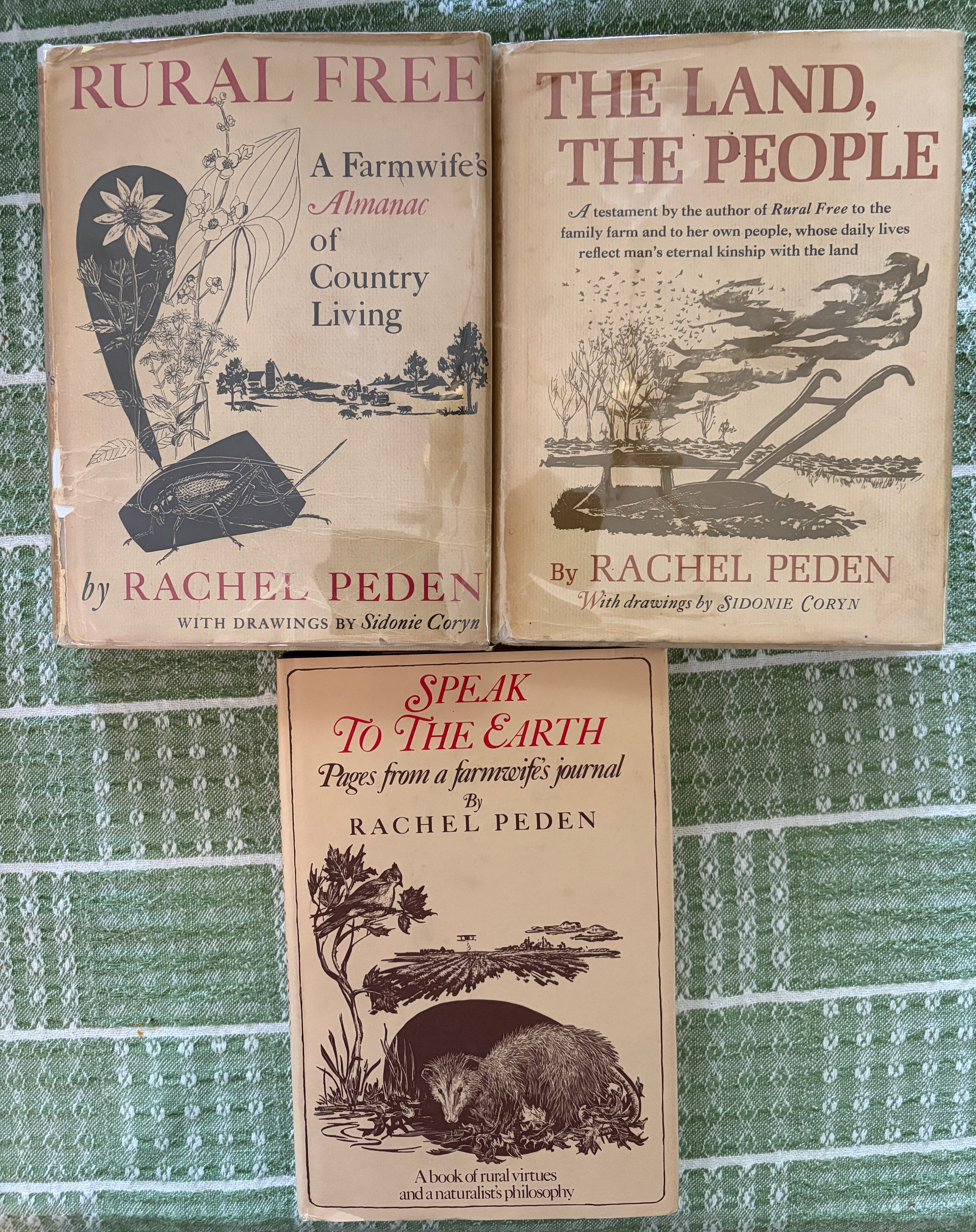
Rachel wrote three books1, all more or less based on her columns:
Rural Free: A Farmwife’s Almanac of Country Living was published in 1961. From the front cover flap of Rural Free:
“This is a nature book, a country book, a farm book, a book of living things for all people who rejoice in the rural virtues and in the spiritual freedom of the country life. In a time when the complexities of urban life are hurling thousands into the suburbs and country, this book is like a breath of fragrant country air redolent with sweet clover and timothy.”
She starts with September and goes through a year on the farm. Now would be an excellent time to start listening to it as an audiobook or reading the actual book via a good used copy.
The Land, the People was published in 1966. On the cover it says,
“A testament by the author of Rural Free to the family farm and to her own people, whose daily lives reflect man’s eternal kinship with the land.”
This is a more personal look at the land where she grew up and land farmed by her father-in-law and others. It has four main sections. She wrote for the front flap of the cover:
“I wanted the land to be the main character, and to write about the family farm, its change, survival, character, and of people’s love of the land and need of it as a basic human hunger—I wanted to tell of the uses of a particular part of Monroe County (now in forest reserve) which was once used by Indians, later was the seat of a little trading village, later still was an orchard farm on which I set my childhood—the result is a book almost too personal for the author’s comfort.”
Her third and final book was Speak to the Earth: Pages from a farmwife’s journal, published in 1974, just a year before she died. Of this book, she wrote,
“The family farm has joined the list of endangered species, but there is reason to believe it need not become extinct.”
Fortunately, the Peden family farm is still here. Before there was such a thing as “agro-tourism,” the Pedens opened up their farm for school field trips, and it grew into the Children's Farm Festival at the Peden Family Farm, which continues today.
More Nuggets From Her Columns
As mentioned, I read through several of Rachel’s columns in the newspapers.com archives. Here are a few passages that I especially enjoyed.
From August 18, 1958, in her column The Almanac of Poor Richard’s Wife in The Indianapolis Star:
“The sound of rain, like the sound of an orchestra, is not a single sound, but one composed of many sounds. You hear it first as one, but if you listen you hear the many. Sound of drops falling single; sound of splashing; running sound of many drops gathered together into a little rivulet; sighing, swishing sound of drops striking the leaves and falling past in a steady, repeated pattern. Added to the sounds of rain itself, and almost inseparable from these, are the accompanying, almost symbiotic sounds, thready voices of crickets, jar-flies and katydids singing in spite of rain, of small birds muttering in their sleep about the rain; and inside an old farmhouse, the sighing or creaking and snapping that means the old house had heard the rain and is gently resigning itself to it.”
And from September 23, 1961, her description of goldenrod and other roadside weeds and wildflowers:
“Goldenrod is coincident with the opening of country schools. This year the flowers of it seem more than usually bright and as yet wholly untarnished. Right now patches of it in the unmowed fields, along fence rows and along country roads, are at their level best, giving one the feeling that a great deal of pure gold has been carelessly dumped all over the ground and either washed by rains or blown by wind, into these bright collections.
One can still find occasional accessory notes of bright blue from star bellflower, vervain and lobelia. In the woodsy hillsides are clumps of tiny lavendar asters, as if they had climbed that far and stopped to look back, catch their breath and beckon to neighbors passing along the road. In the more watery soil knotweed grows, waving its pink, beadlike heads of bloom in the wind; and the flimsy yellow silk of evening primrose stays open all day, as if the flower knew that no time should be lost about enjoying the short bliss of this exciting autumn weather.”
Finally, from February 10, 1962:
“One of life’s greatest compensations is the opportunity to say “I told you so!” For years now we have been agreeing with a country schoolteacher who says “Children do, too, like poetry. They simply eat it up. There’s never enough poetry on the bookwagon.” It’s a fact that people remember poems from their school-hood grammars, spellers and readers and when they come upon them in later years it’s like meeting old school friends who have not aged at all. It’s a pleasure to identify the source of lines from a poem. We discovered this last week, when we couldn’t find the line about “Up the airy mountain, down the rushy glen.” We got letters, for which we thank the writers sincerely. Now we know the lines are from an Irish poet, William Allingham, born in 1824. The poem is “The Fairies,” and all of it is lovely in a delicate, wild imaginative, Irish way.”2
You might be tempted to dismiss Rachel’s books as not worth your time reading because you think she wrote mainly of farm life in Indiana, which isn’t of great interest to you. I hope the writings I pulled from her newspaper columns convince you to give her books a try, anyway. All three books are available online.
Tea with Rachel
I usually end these posts with an imaginary tea with the latest Lost Lady of Garden Writing and suggest some questions I might ask, but for Rachel, who was known to be shy, I think I’d just like to go on a tour of her farm and gardens, then sit on the porch and enjoy some freshly squeezed apple cider.
How about you?
Who’s Next?
I have another author in mind for the next Lost Lady of Garden Writing. I’ll bring her to this Substack in two weeks on September 16, 2026.
A personal note. I found out a few days ago that I was awarded a Gold Laurel Award from Garden Communicators International for blog writing for this Lost Ladies of Garden Writing Substack. I’m thrilled and delighted!
I now own first editions of all three of Rachel Peden’s books, and two of them are signed by the author. I ordered a “good, used copy” of Speak to the Earth after listening to the audiobook edition of Rural Free. Then on a visit to the local Half-Price Books, I saw signed copies of Rural Free and The Land, the People on display. They were priced a little higher than I wanted to spend on “good, used copies” so I passed them up. Not once, but twice. Then after reading more about Rachel, I rushed back to HPB, found the books still on display, and bought them. I will enjoy reading all three of them.
If you are interested in reading William Allington’s poem The Fairies, I found it online here.
Congratulations on the gold award! Well-deserved.
Thank you for this post. My good friend shared copies of R Peden's books.
My friend is a watercolor artist and Ms. Peden's granddaughter has purchased a few of her works