


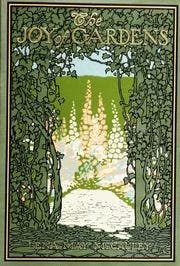
I saw a picture of The Joy of Gardens by Lena Mae McCauley on Instagram, via Honey Bee Mill Books (a dangerous site for me to browse!) I was intrigued, as I usually am, whenever I discover another Lost Lady of Garden Writing.
My brief online searches for Lena turned up several interesting tidbits about her life, but I never found a picture of her. I thought it was unusual to not find any photos, considering how many hits I got with her name when I searched through newspaper archives.
Regardless, I’ve tried to use the information I did find to come up with a brief biography
Her Biography
Lena Mae McCauley was born May 2, 1859 to James and Lena Rowland McCauley in Hagerstown, Maryland. Shortly after, the family moved to Chicago, Illinois. In the 1900 census, Lena’s occupation was schoolteacher. Her career apparently turned to journalism shortly thereafter. In the 1910 census, she was a journalist, in the 1920 census, she was an editor, and in the 1930 census, she was an art editor.
In all the census records she is living with her parents, or her mother and sister, or with a niece, first in Chicago and later in Evanston, Illinois. She died on November 28, 1940, aged 81.
Her Art Editor Career
I didn’t expect when I looked at articles about her work as an art editor that I’d follow her trail to Brown County, Indiana. I found an article in the Franklin Democrat, in May 1920:
Lena M. McCauley, art editor of the Chicago Evening Post, in an article in that paper Tuesday says of Brown county and her landscape beauty:
"Brown county, embracing the foothills of the lost mountains in southern Indiana, was created to be the happy hunting grounds of the landscape painter of the middle west. Go forth from Nashville with paint box, stool and easel in any direction day after day and behold ever new and interesting landscape material ready for composition.
"The hills crowd Brown county. Between them race the little creeks, rippling musically in the springtime over stony ledges. The forest trees crowning the hills are mirrored in quiet pools, on whose banks just now the dogwood and redbud rise from beds of violets to gaze at their reflections, while the Kentucky cardinal sings from dawn to dusk. The little creeks twist and turn to see the sunrise and the sunset vistas breaking their way between stony banks or rounded hills, and every little while widening in peaceful valleys, where the farmer has set his log cabin among fruit orchards and tills his few acres.”
I also tried to figure out if Lena’s path ever crossed with the path of Mrs. Kate L. Brewster, another Lost Lady of Garden Writing, who, with her husband, collected art and was involved in the beginnings of the Art Institute of Chicago around the same time that Lena was the art editor for the Chicago Evening Post. I couldn’t find anything in the newspapers that showed they were at any event together, but surely they must have known each other or at least knew about each other.
Her Environmental Awareness and Advocacy
I found two more articles that showed me that Lena was an advocate for the environment in general, in addition to advocating for art.
In an article in the 1917 Times-Herald, Lena was appalled at the billboards in Washington, D. C.
And I quote from the article:
Bitter protest against the presence in the National Capital of billboards bearing advertisements was voiced today by Miss Lena M. MoCauley, art critic of the Chicago Evening Post, and one of the speakers at the final session of the eighth annual convention of the American Federation of Arts, at the Raleigh today.
"Pertectly atrocious," was the phrase which Miss McCauley used to denote her displeasure at finding billboards were permitted in the downtown and residential section of Washington.
"In Chicago," Miss McCauley continued, "we have waged a successful fight against this menace to art, and I am happy to say that now there cannot be found one billboard in the residential sections of that city. "Imagine my chagrin as I saw from the car window coming into Potomac yards the scores of billboards marshaled in gaudy array, flaunting the merits of some choice tobacco or popular chewing gum. I was astonished to see such a sight in my Nation's Capital."
Vigorous applause greeted Miss McCauley's remarks, and it was suggested that the convention spread her protest throughout the country until every city in the United States is protected by legislation like that in Chicago.
Lena was also a member of the Wild Flower Preservation Society, Illinois Chapter. In “News of the Chicago Women’s Clubs” in the Chicago Tribune from June 1928, they noted that Lena had been named the president of the organization. I thought maybe searching for this club might turn up a group photo of the officers, including Lena, but it didn’t.
Her Gardening Book
Lena’s gardening book, The Joy of Gardens was published in 1911. The book is online if you’d like to read it.
She organized the book by months, and uses each month to go deep into some aspect of gardening. As one person wrote in 1911 in their review of the book, published in the Omaha World Herald in 1911, she did so “thoroughly.”
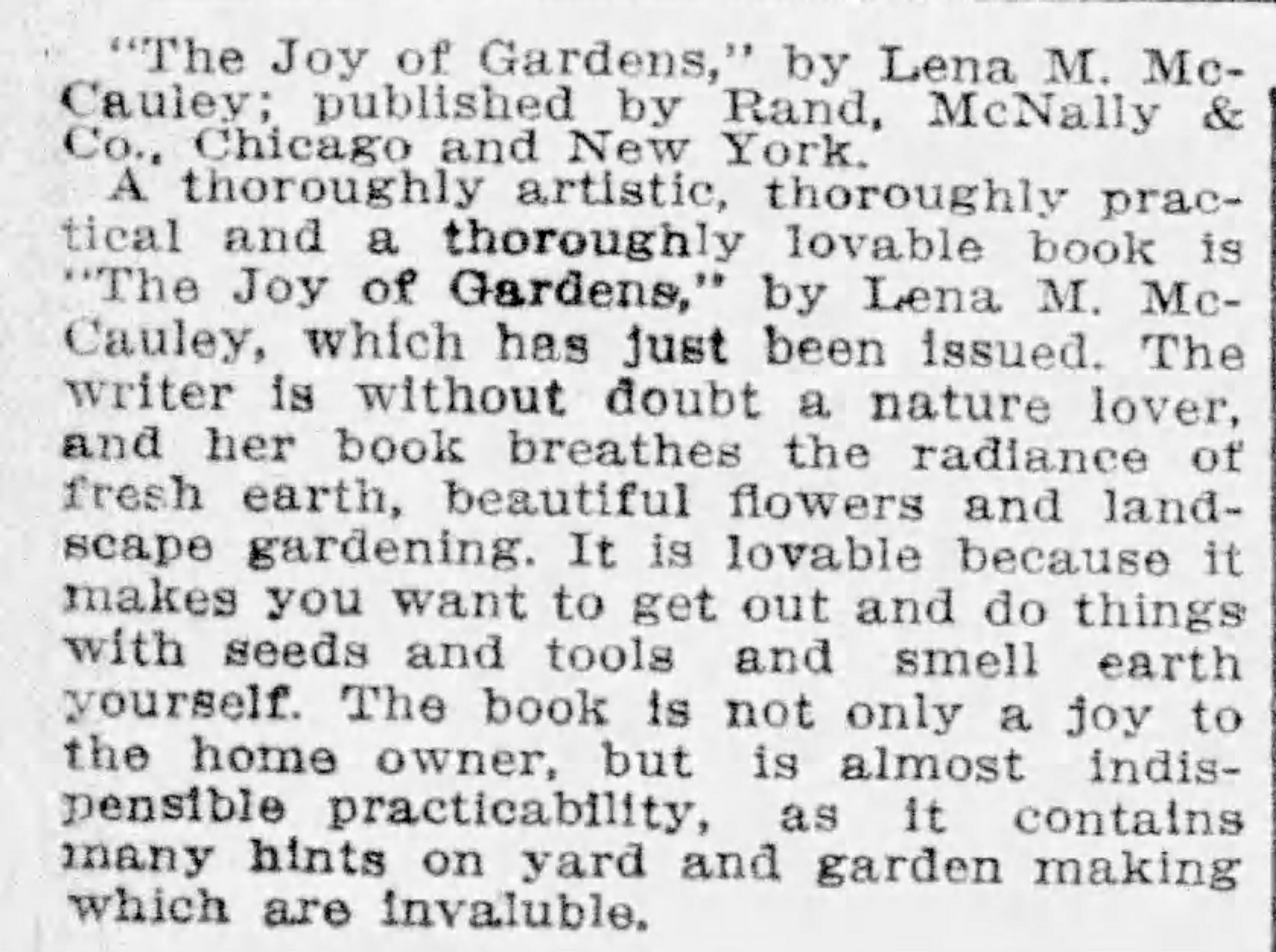
And I quote:
"The Joy of Gardens," by Lena M. McCauley; published by Rand, McNally & Co., Chicago and New York.
A thoroughly artistic, thoroughly practical and a thoroughly lovable book is "The Joy of Gardens," by Lena M. McCauley, which has just been issued. The writer is without doubt a nature lover, and her book breathes the radiance of fresh earth, beautiful flowers and landscape gardening. It is lovable because it makes you want to get out and do things with seeds and tools and smell earth yourself. The book is not only a joy to the home owner, but is almost indispensible practicability, as it contains many hints on yard and garden making which are invaluble.
I read through parts of the book, and was struck by how some things never change in gardens and gardening, good and bad.
She wrote about people stealing plants from a garden.
“One of the privileges of pride in gardening is showing off its treasures to friends. It is a pure delight, for you are parading the glories of nature. And what think you when, boldly before your watching eyes, some thoughtless guest breaks off the seed that you have been nursing for days? What would you do when they take "slips" from your symmetrical begonias and geraniums? What say you when they wait till your back is turned and help themselves to a root of your choice dahlias, or smuggle a hoped-for Mefistofile or Baron Hulot gladiolus in their pockets?”
She also warns about overwatering in her chapter for the month of July.
“More gardens have been ruined by careless sprinklers than by a dry spell, and sometimes weed pulling, stirring the sun-baked beds with a hoe, and faithful clipping of seed pods and dry flowers, will keep blossoms unfolding in a healthier condition than if sprinkled. The calendulas, marigolds, coreopsis, calliopsis, and petunias should begin to look their best, and if an annual does not show ambition, now is the time to pull it up.”
And have our thoughts about morning glories changed much?
“Have you lost your faith in miracles? Then rise with the sun tomorrow, when garden and orchard and meadow are jeweled with dew. Stand before the humble morning-glory that you have despised, and while you look and would count the sparkle of crystal drops upon the emerald leaves, a host of flowers unfurl at some divine com-mand, chalices of pearl and blue and rose are lifted in adoration before the shrine of the rising sun, bringing another day to a thoughtless world waking under the. azure skies and yet forgetful of the heavenly presence.”
Morning glories are still despised today, if you let them take over your garden!
You might enjoy reading passages from Lena’s book if you are looking for that elusive “joy” in your gardening efforts. Or maybe read it to find out that over one hundred years later, we still have a lot in common with gardeners of the past.
The book is illustrated with several photos of gardens, mostly black & white but a few have been colorized. Some indicate only where they were; a few list the name of the owner.
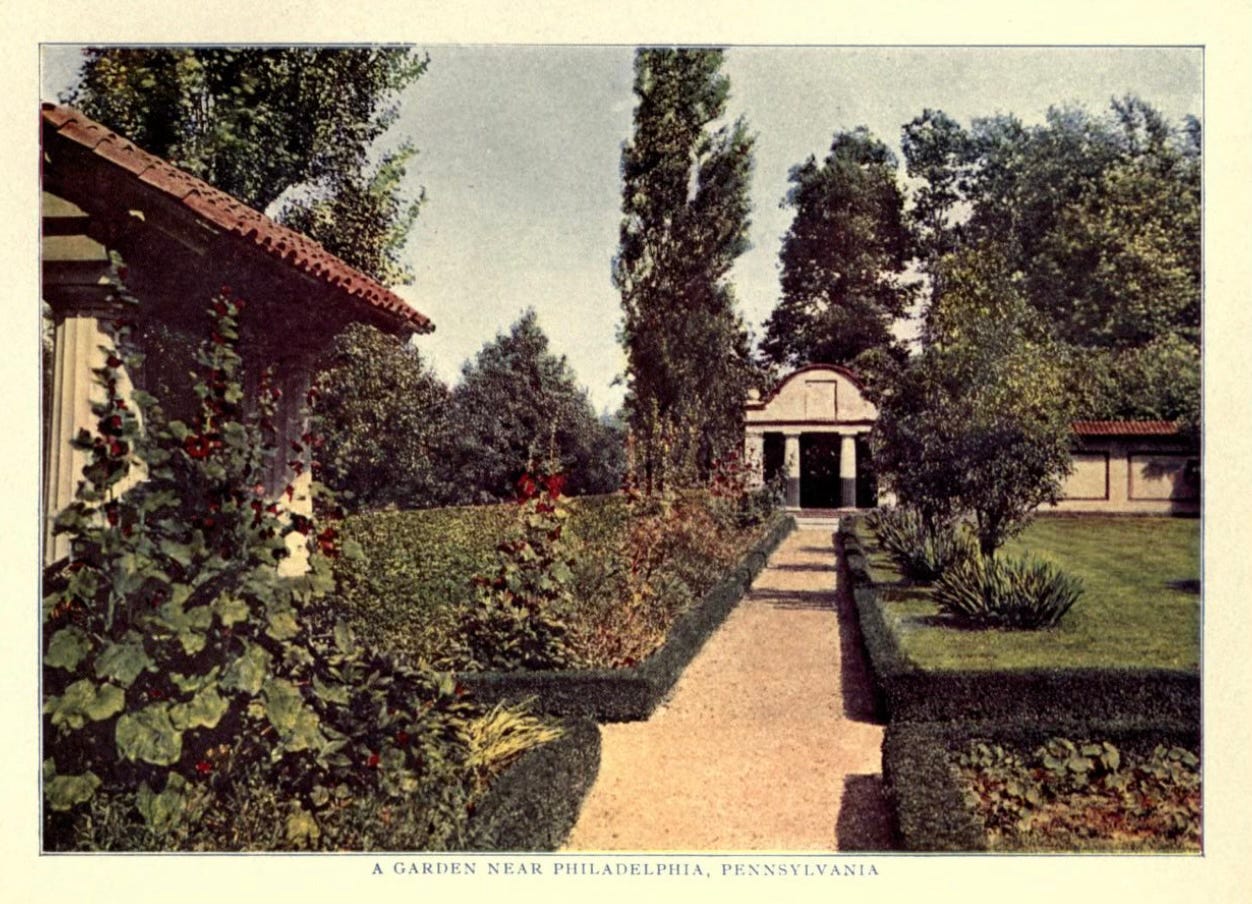
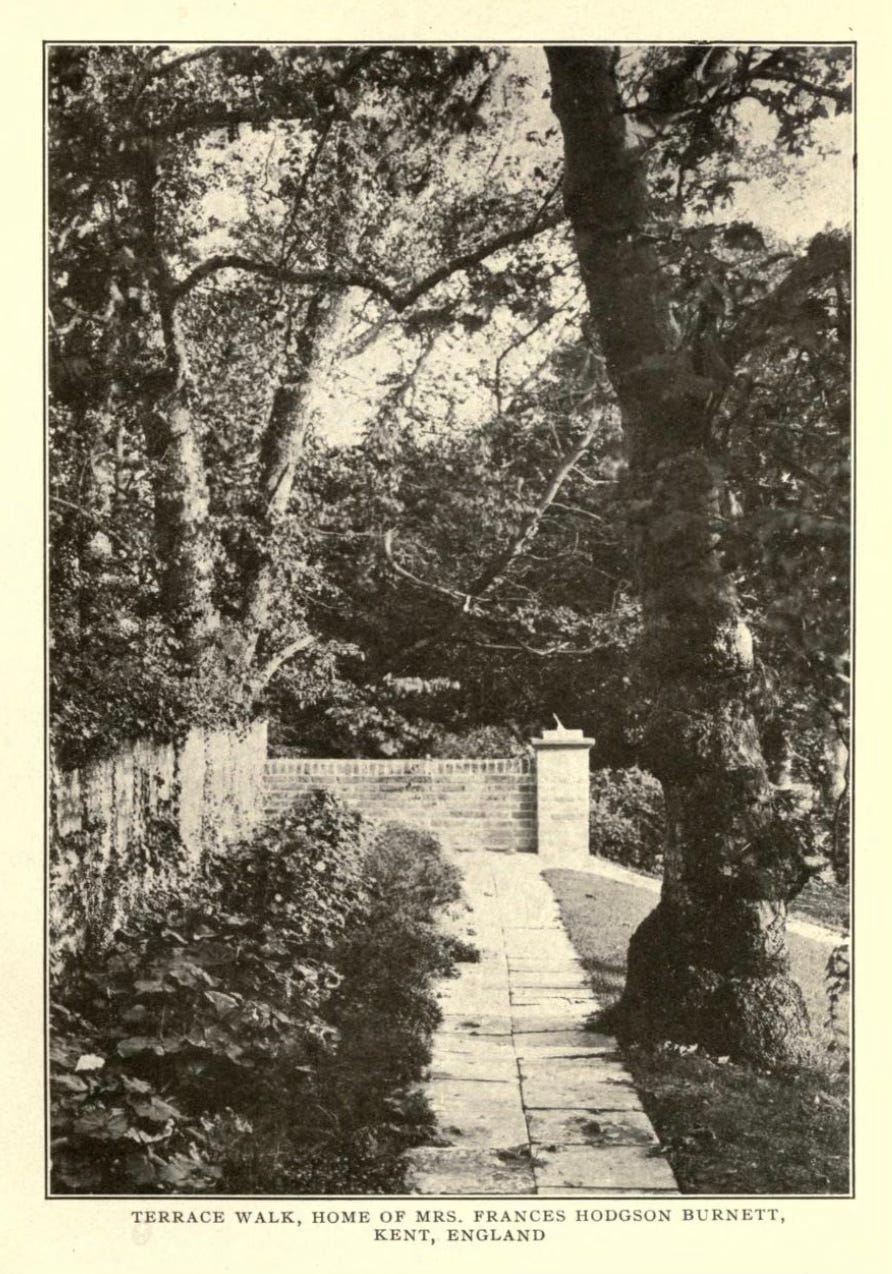
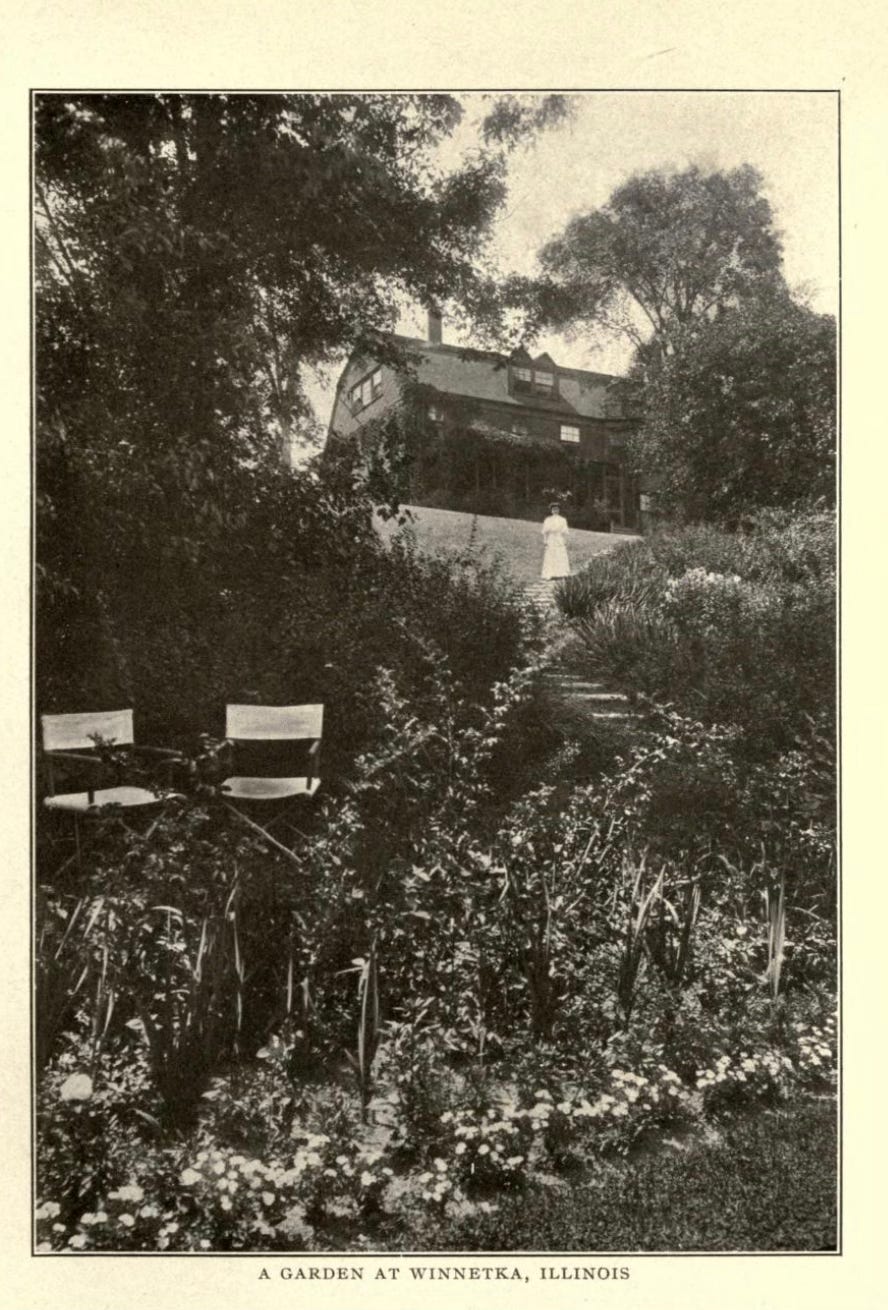
Could that be our Lena Mae McCauley standing at the top of the hill in that last photo? We’ll never know, nor will we ever know the full story of today’s Lost Lady of Garden Writing.
Unanswered Questions
As usual, these very brief glimpses into the lives of Lost Ladies of Gardening Writing leave us with more unanswered questions. Where did Lena go to school? Did she ever meet Kate L. Brewster? And why did she only write one gardening book?
Do you know of other women authors of gardening books that I should research as Lost Ladies of Garden Writing? Send them my way via a comment or email!
If you find these articles interesting and think others will, too, please share them and/or subscribe.
I’ll return with the next Lost Lady of Garden Writing article in two weeks on August 20, 2025. In the meantime, you can find me in several places: my website and blog, The Gardenangelists podcast, and my weekly newsletter, In the Garden With Carol.
Thank you for this. Your pieces on the lost ladies of garden writing are always so interesting! Aside from all her work, I love this one's name and her love of morning glories. I live in high and dry Colorado Springs, Colorado and there's not a problem with them taking over here. We need the naughty ones who can survive a tough climate.
One wonders if the photo of Mrs. Frances Hodgson Burnett's garden is indeed that of the author of "The Secret Garden". Thank you for this lost lady!