


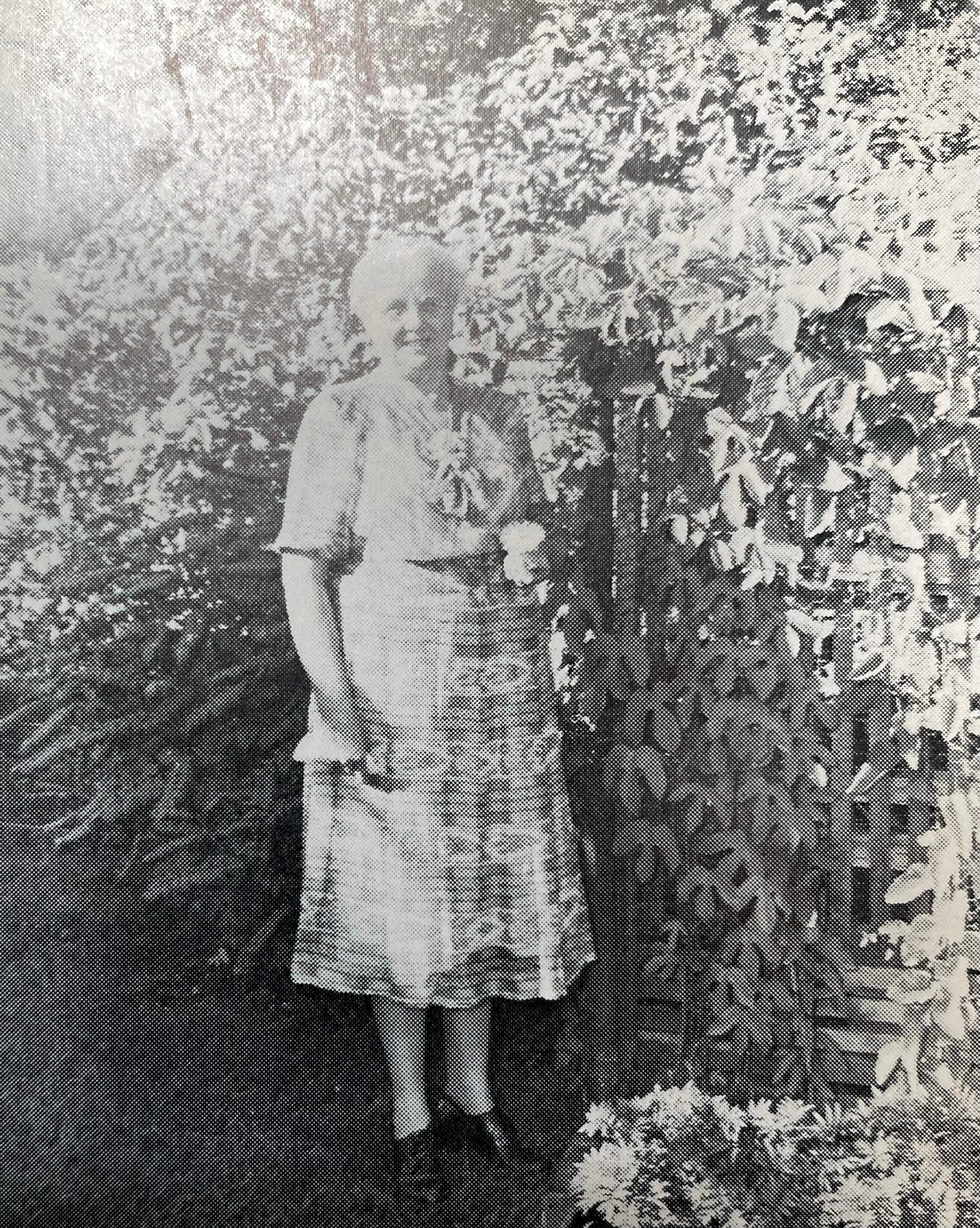
Meet Florence Knock, who assembled this country’s largest private collection of passionflowers in Minnesota, of all places, and wrote a guide to growing them.
I learned about Florence, the next Lost Lady of Garden Writing, when my garden writing friend, Ellen Zachos, sent me her copy of Passifloras for Your Garden by Florence Knock.
I had not heard of Florence, so I spent some time reviewing her book and, of course, searching for more details about her on various websites. I discovered some interesting tidbits, as I generally do, and some connections she had to other garden writers.
Her Biography
Florence was born August 30, 1887, in Minnesota, the sixth of seven children of Carl O. and Mary B. Abrahamson, immigrants from Sweden. Her full name was Lillian Florence, but in some records, she shows up as L. Florence or Florence L. According to the biography on the back flap of her book’s cover, everyone called her Florence.
In 1907, Florence graduated from Gustavus Adolphus College in St. Peter, Minnesota, from the “Academy and School of Pedagogy.” In 1916, she married Arthur W. Knock, a Lutheran minister.
Between graduating from college in 1907 and getting married 1916, I think Florence mostly taught school. I also found newspaper references to Florence singing as a soprano in various performances and enjoying life with her friends, who once celebrated her birthday with a surprise party. That was in the days when a surprise birthday party, a concert, or a celebration of the end of a school term made the local paper!
Most of the newspaper articles I found about Florence after she married focused on the events, committees, and other activities which she participated in as a Lutheran minister’s wife.
Florence passed away in December 1983, at the age of 96. Arthur died 14 years earlier in 1969. They had no children.
Her Garden Writing Biography
Thank goodness the book Ellen sent me still has the cover on it, because that’s where I found Florence’s “garden writing biography.”
“Mrs. A. W. Knock is known affectionately as “Florence” by gardening friends all over the world. She is the wife of a busy Minneapolis clergyman, and her gardening success goes back many years. Since 1956 she has been sharing her knowledge worldwide by means of personal correspondence and through dozens of magazine and newspaper articles that have appeared in The Begonian, Flower and Garden, Flower Grower, Popular Gardening and Living Outdoors, Horticulture, the New York Times, Gardener’s Chronicle, The Gloxinian, Ozark Gardens, and Back to Eden. Since 1964 she has been Northern Editor of Park’s Floral Magazine.
Passiflora for Your Garden is a natural outgrowth of Mrs. Knock’s deep interest in these plants. Her window garden in winter and her garden outdoors in summer provide a home for this country’s largest private collection of passifloras. Other special plant interests include begonias and gesneriads. Mrs. Knock’s own hybrid begonia ‘Fleecealba’ is a favorite cultivar, and sinningia ‘Florence K.,’ created by Peggie Schulz, is named in her honor.”
Her Correspondence
Whenever I read that a Lost Lady of Garden Writing corresponded with other gardeners about plants and gardening, I immediately think of the southern garden writer, Elizabeth Lawrence. Elizabeth was well known for corresponding with many gardeners and often referenced them in some of her books. In Elizabeth’s book, Gardening for Love: The Market Bulletins, I found information on her correspondence with Florence:
“One of the contributors to Ozark Gardens is Florence Knock. Mrs. Knock and I began to exchange letters and plants during the Second World War when people had more time than money. We belonged to a seed exchange with members all over the country…
“All my tender bulbs are in the garden now,” she wrote me one June. “I set them out on the eighteenth of May. I have more than fifty amaryllis hybrids, white ismene, achimenes, chlidianthus, lachenalia, sprekelia, and three pots of Vallota speciosa. Do you care to exchange for any of the above? If so let me know.” I sent her some Zephyranthes candida, and she sent me a vallota. The vallota went into the ground and that was the end of it. I don’t know how the zephyranthes fared, for there was a gap in our correpondence when I moved from Raleigh to Charlotte. Then I came across some articles about passion flowers that Mrs. Knock published in Flower and Garden, and I wrote her through the magazine…
Another person Florence corresponded with was the prolific garden writer, Elvin McDonald1. At the beginning of her book, Passifloras for Your Gardens, she wrote,
“My deep appreciation to Elvin McDonald, my long-time friend, who has helped in the building of this book from its beginning.”
How did Florence and Elvin meet? I don’t know how, but I do know he was a teenager when they began sharing information about plants. In his syndicated column called The Indoor Gardener, which I found in a search of Newspapers.com, Elvin wrote in February 1978:
“That’s how I got to know the passion flowers. It was the summer of 1953 (I was 16) and I went to visit my plant penpal, Florence Knock, in Minneapolis. Much to my surprise, her small garden contained more species of Passiflora than perhaps any other in the world.”
I once briefly met Elvin McDonald a few years ago, which means I’m one degree of separation from Florence!
Her Book
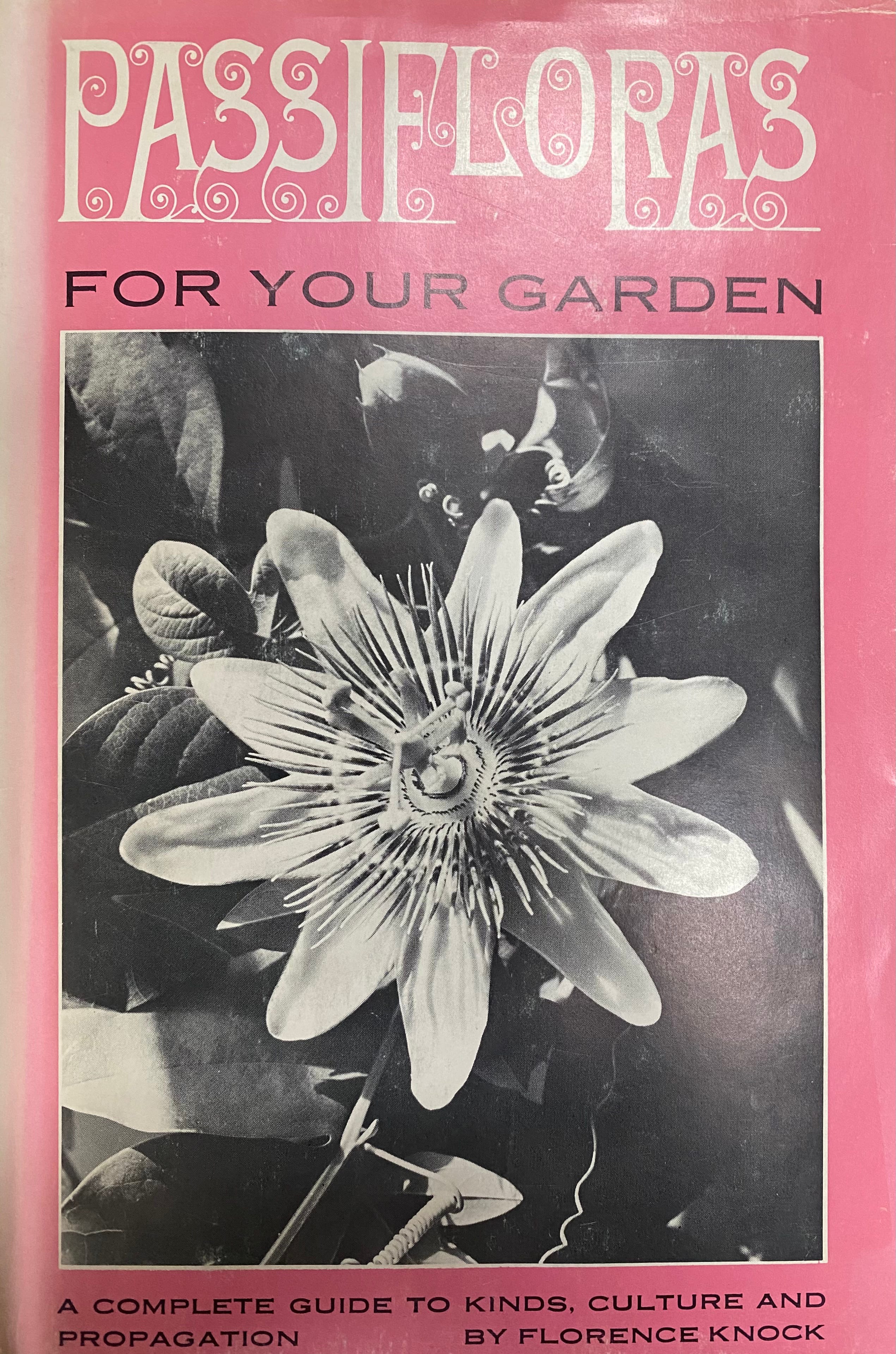
Though Florence was a prolific author of gardening articles, her one book, as far as I know, was Passifloras for Your Gardens, published in 1965 by Diversity Books, Kansas City, Missouri. It was published when she was 78 years old.
The book is a slim 100 pages, with enough information to help anyone who wants to grow these fascinating flowers. She began with a chapter titled “Passifloras: A Living Legend for Your Garden.” It’s an interesting and detailed description of how the various parts of the flower are used to tell about the crucifixion of Christ.
In the second chapter, “Passifloras on the American Scene,” she wrote about how she first discovered passifloras while living in Berkeley, California in the 1920s and was surprised when she moved back to Minnesota that a neighbor was growing them in his garden. (If you aren’t familiar with U. S. geography, Berkeley, California, is hardiness zone 9b-10a, and Minneapolis, Minnesota, is a much chillier hardiness zone 5a, much too cold for passifloras to survive a winter outdoors.)
Florence shared in her book that the secret to growing passifloras in Minnesota (or any climate where temperatures dip below freezing in the winter) was taking and rooting cuttings to overwinter indoors before planting them out in the garden in the spring.
In her book, she also included chapters on growing passifloras in containers and propagating them, plus a list of nurseries where you could buy them. I think only two or three of the nurseries she listed in her book in 1965 are still around. One of those is Logee’s.
I’m really tempted to buy a Passiflora vine to grow this spring in my garden after looking through this book. Thanks, Florence!
Quotes From Florence
I enjoy finding quotes to share from the Lost Ladies of Garden Writing. Here are two from Florence’s book.
“Earnest horticulturists always find a way to grow the plants that have won a place in their affection.”
And the last sentence in her book:
“Since the rose is said to be the queen of all garden flowers, perhaps we may consider that the passionflower is the king of all the exotic and exquisite blooms brought forth in the vine kingdom.”2
Questions for Florence
I have a few questions for Florence, which I would ask if she was still alive.
What happened to your rather large collection of passionflowers and many of the other plants you collected, like those fifty Amaryllis hybrids?
You wrote your book rather late in life. What prompted you to write it?
Where can I find Sinningia ‘Florence K.’? I suspect it’s a lost cultivar, as so many of the old ones are! And what can you tell me about your neighbor, Peggie Schulz, who named it after you?
Who’s Next?
While researching Florence, I found a few other women garden writers to add to my list, including her neighbor, Peggie Schulz. I might write about her next, or maybe I’ll write about someone else who has been patiently waiting on my growing list. Whoever she is, she’ll be featured in my next article, coming on November 26.
If you know of a woman garden writer from the past whom I would enjoy researching, feel free to comment below or send me an email. My list always has room for more.
And let me know if you grow passifloras and have some tips for those of us who live where winters are freezing cold.
For more information about Elvin McDonald, author of 75-plus gardening books, who currently lives in Des Moines, Iowa, I recommend a simple internet search or check out this article from the Des Moines Register from 2022.
Is it one word, “passionflower,” or two words, “passion flower? ” Since Florence wrote it as one word, I’m going to do the same. She was the expert!
I thoroughly enjoy this series, and think this is unique and important. I truly hope that you compile these articles into a book, perhaps even a small series of volumes because you're never done.
On a different note, I wonder if Laura Ingalls Wilder ever wrote about her garden or the family orchard? She's famous for writing about her pioneer childhood, but lesser known now for her article writing - for decades she wrote the column "As A Farmwoman Thinks" in The Missouri Ruralist. She was known for her poultry keeping practices, but she naturally kept a garden and orchard was the main income source. Might be worth looking into?
Thank you for this recommendation! I thought I had about all the books relating to Laura and her family, but not this one!